
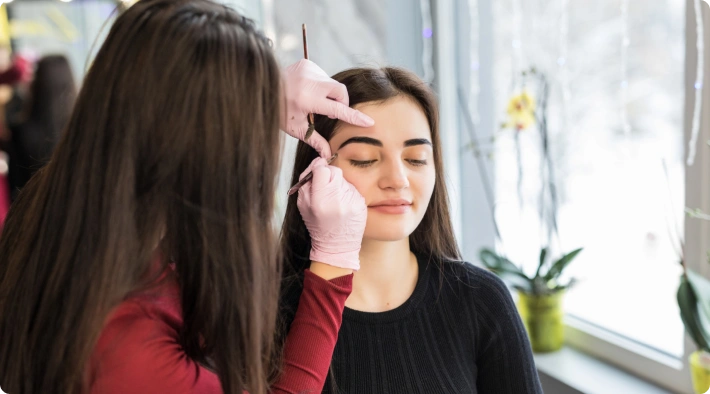
Even seasoned artists always argue about this. SPMU or PMU? Two terms, same treatments, and still the Indian beauty industry uses both as if they are describing completely distinct things. They’re not. And that confusion is costing aspiring artists clarity right at the moment they need it most, when they are deciding which path to take, which course to join, and which career to pursue further.
India’s permanent makeup market is increasing by leaps and bounds. It is projected to grow from $1.24 million in 2024 to $2.74 million by 2032.
This growth is pulling in thousands of beauty professionals and career-switchers who want to work in this space. But before anyone enrolls in a course or picks up a machine, one question keeps moving around in every studio, every training group, and every client consultation: what is the difference between semi-permanent and permanent makeup? Fortune Business Insights
Most people assume SPMU is a softer, newer version of PMU. Others believe PMU lasts forever, while SPMU fades within months.
In this article, we’ll sort out what both really mean, whether there’s a technical separation between them, and why it matters a lot for anyone exploring semi permanent makeup courses in India, and what you should know before you step into this field professionally.
What Is Semi-Permanent Makeup (SPMU)? Let’s Understand
Semi-permanent makeup is a cosmetic approach. A technique where pigment is placed into the upper layers of skin with a specialized machine or a handheld tool. People resonate and think it is similar to a traditional tattoo, but it is not. Though the pigment is positioned around the dermal-epidermal junction tends to be shallower than the ink used for body tattoos. That difference is basically why the results fade gradually as time goes on rather than staying permanently “locked” in.
SPMU covers three primary areas: Brows, Lips, and Eyeliner.
- Brow techniques include microblading, ombre powder brows, nanoblading, and combination brows.
- Lip work covers lip blush, lip neutralization for darker or uneven tones, and full lip colour.
- Eyeliner focuses on tight lash-line enhancement.
What Is Permanent Makeup (PMU)?
Permanent makeup uses the same basic path. Pigment is put into the skin with a machine or a more manual tool. It is done across similar treatment zones, brows, lips, and eyeliner.
The techniques are identical. The equipment is largely the same. So why does a different name exist at all?
It comes down to geography and marketing, not science.
In the United States, “permanent makeup” is the standard term. In India and Australia, artists and academies prefer “semi-permanent” because it sets more honest client expectations. Calling something permanent implies a lifetime commitment. This creates problems when clients come back two years later and ask questions about why their brows are fading.
Traditional PMU, particularly older methods using synthetic or carbon-based inks, placed pigment slightly deeper into the dermis.
Those formulas lasted longer but had a known drawback, such as colour shifting. Over time, dark brown pigments would go grey or bluish tones, and lip colours would oxidise into uncomplementary shades. That is the version most people still picture when they hear permanent makeup. Nowadays, modern practice has moved away from those older mixes. Iron-oxide-based pigments are basically the current industry standard, fade more cleanly and pretty consistently, in a way that makes the outcome easier to anticipate. Yes, regardless of whether the artist calls their work SPMU or PMU.
So, Is There a Technical Difference Between SPMU and PMU?
This is the question the entire article builds toward, and the answer honestly is: not much of one.
- Both use pigment deposited into the skin.
- Both cover brows, lips, and eyeliner.
- Both require touch-ups every one to three years.
The techniques, microblading, ombre, lip blush, and nanoblading, are shared across both. An artist offering PMU and an artist offering Semi Permanent Makeup are largely doing the same work with the same tools.
The Pigment Depth Difference
Pigment depth is the only significant difference. Semi-permanent makeup deposits pigment at the dermal-epidermal junction, the boundary between the outer and middle skin layers.
Traditional permanent makeup puts pigment a little farther down into the dermis. That extra depth meant results that lasted longer, but it also made the fading less predictable, and there’s more chance of colour shift as time goes on.
The Pigment Formula Difference
Older PMU used synthetic or carbon-based inks that held colour longer but oxidised badly over the years. Modern SPMU uses iron-oxide-based pigments that fade more evenly. It gives artists and clients the flexibility to adjust shape and colour at every touch-up appointment.
Why India Prefers the SPMU Term: The Decoding
The terminology difference is mostly regional and more or less a marketing preference. In India, the beauty industry grabbed semi-permanent makeup as the chosen term, because it somehow tells clients what they should know from the start: this procedure needs refreshing, it is not a one-time decision, and the outcome will change with your face over time
That framing protects both the client and the artist, and it is why structured semi permanent makeup courses in India teach terminology, client communication, and expectation-setting alongside technique.
How Long Do Results Last, and What “ACTUALLY” Determines That?
Most articles just stop at “one to three years,” and then they move on like nothing. But that number means nothing without context. Longevity in SPMU and PMU is never fixed. It can shift, it blends a little based on several factors, and learning about those factors is what really separates a trained artist from someone who only did a weekend workshop.
- Pigment Formula
Iron-oxide-based pigments, the current standard in semi-permanent makeup, fade more evenly and cleanly than older synthetic inks. Organic pigment formulas tend to hold colour longer in the skin. Neither is universally better. What counts the most is matching the formula to the client’s skin type and the technique being used.
- Skin Type
Oily skin breaks down pigment faster. Clients with oily or combination skin will see their microblading fade significantly quicker than clients with normal or dry skin. For oily skin types, machine-based techniques like ombre powder brows hold up considerably better over time.
- India’s Climate
This is the element most global content just ignores. Heat, humidity, and steady sunlight speed up pigment fade, much faster in India than in climates across Europe or North America. An artist trained on international content without India-specific knowledge will consistently underprepare clients for how quickly results can shift in Indian conditions.
- Skincare Habits
Retinols, AHAs, BHAs, and chemical exfoliants all kind of speed up cell turnover. So it pushes pigment out of the skin faster. Clients using active skincare ingredients need to know this before their appointment and adjust their routine during the healing period.
- Artist Skill
Consistent needle depth is a technique issue. An artist who lacks proper training in depth control will produce uneven results that fade unpredictably (regardless of the pigment brand used). This is why choosing a structured semi permanent makeup course with hands-on technical training matters far beyond just receiving a certificate.
Techniques That Fall Under SPMU and PMU
One of the biggest misconceptions is that SPMU and PMU have different technique sets. They do not. The same treatments sit under both umbrellas. What changes are the depth, the pigment formula, and the artist’s training, not the name of the procedure itself.
Brow Techniques
- Microblading uses a handheld manual tool to draw separate hair-like strokes into the skin. It gives the most natural-looking brow outcome, but it seems to fit normal to dry skin best. For oily skin, the strokes can erode faster, so this method becomes less dependable for a big chunk of Indian clients.
- Nanoblading gives you that same hair-stroke vibe, but it uses a machine needle instead of a hand-held blade. And in practice, the strokes come out finer and more accurate, so it tends to suit a pretty broad spectrum of skin types too.
- Ombre powder brows (on the other hand) deliver a softer shaded look that feels like a brow that’s filled in. This technique generally works well across all skin types and holds up better in humid climates. This is why it’s often considered one of the more practical picks for Indian clients.
- Combination brows sort of mix hair strokes at the front, plus shading that fades through the rest of the brow and tail. Somehow the whole look ends up more dimensional, fuller, and it stays there for longer, like it doesn’t quit fast.
Lip Techniques
- Lip blush gives this little soft wash of colour, it helps bring out the natural lip shape, yet it doesn’t look like too much. Right now, it’s one of the fastest-growing semi-permanent makeup treatments in India.
- Lip neutralisation works first. It corrects those dark, uneven, or pigmented lips before any colour gets layered on. This technique is especially relevant for Indian skin tones. The reason natural lip pigmentation often goes deeper. That makes it more noticeable in a lot of people.
- Full lip colour delivers complete saturation with a defined shape, closer to the look of a lipstick application that does not come off.
Eyeliner Technique
- Tight lash-line enhancement deposits pigment directly between the lashes, defining the eye naturally without the appearance of visible liner. It is the most wearable eyeliner technique for everyday use.
Understanding these techniques is the foundation of any serious semi permanent makeup course in India.
The Bottom Line
After all those discussions above, it comes to one common point. Semi-permanent makeup and permanent makeup aren’t really two different treatments. More like it’s just two different ways of describing the same family of cosmetic tattooing.
Those shaped by regional preference, client expectation management, and decades of evolving industry terminology.
The technical distinctions that do exist are pigment depth and pigment formula. It matters more to the artist performing the work than to the label on the service menu. A client sitting in your chair does not care whether you call it SPMU or PMU. They care whether their brows look natural, whether their lip colour suits their skin tone, and whether the results last as long as you told them they would.
Seriously, this comes from high-end training. The kind of training that covers skin histology, pigment chemistry, colour theory for Indian skin tones, and hands-on practice before a single paying client is touched.
If you are evaluating semi permanent makeup courses in India and want to understand what thorough, internationally informed training looks like, the place to start is with programs that treat technical depth as a minimum standard, like the one Air Permanent is offering to everyone in India.
The industry in India is growing. The demand is there. What it needs more of is artists who were trained properly from the beginning.
Your structured expert training is just one registration away. Enroll today. Seats are filling up fast.
Let’s Answer Some Questions People Usually Have
Q1: What Should I Consider Before Getting Permanent Makeup?
Answer: It is very important to prioritize the training background of your specialist. Must check their certifications, sanitization standards, and portfolio prior to enrollment or any advance booking. Along with it, personally understand your skin type. The only reason is that oily skin affects pigment retention and requires specific techniques.
Q2: What Are the Common Misconceptions About Permanent Makeup?
The biggest myth is that it stays “forever” without changing. But no, it does not, like really. In reality, it needs periodic color boosts. And also, a lot of people falsely think the procedure uses standard tattoo ink, when in truth it requires specialized cosmetic pigments instead.
Some artists practice. AIR Permanent Artists Master.
AIR Permanent was established for artists who hold themselves to a standard most people cannot see. If that is you, you already know what to do.
Get Your Registration Done
(Online and Offline students are all welcome)