
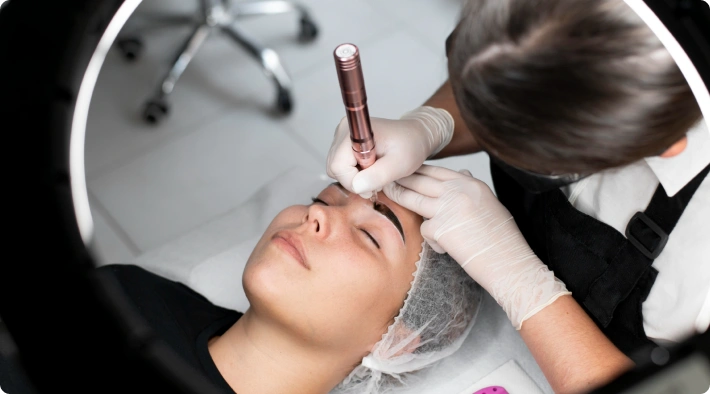
If you are a makeup artist in India or completely new to the beauty industry, you have often noticed the premium prices professionals charge for perfect brows or a flawless lip blush. It is enough to make anyone seriously consider investing in a professional semi permanent makeup training India.
But let’s spill the beans. The moment you think about taking the leap, a wave of hesitation hits you. You start asking yourself: “Is it really safe to use a needle device on someone’s face? What if something goes wrong?”
Yet, the reality today is that almost everyone you know wants wake-up-ready eyebrows and naturally even-toned lips without the daily struggle of makeup pencils. This massive shift in lifestyle is the reason why many are stepping into professional semi permanent makeup training courses. The heart knows the reason. It is one of the most practical and profitable career moves you can make right now.
Whether you are calculating market setup against the standard semi permanent makeup cost in India, or analyzing different beauty career courses to find your footing, you need answers that really help you out. In this blog, we look at the clinical facts, separate old internet rumors from modern skin science, and systematically bust the biggest myths surrounding the procedures of the SPMU.
Anatomy and Procedure Myths: Deconstructing Client Fears
The deepest hesitation students and clients usually have comes down to skin safety. Because the treatment involves a mechanical handpiece, it is easy to assume the worst. Let’s look at the actual science behind how the skin interacts with pigments.
Myth 1: Semi-Permanent Makeup is Just a Face Tattoo
This myth stops many from joining a semi permanent makeup academy India. They fear carrying a harsh, dark mark on their face forever.
The reality lies in skin biology. Body tattoos use carbon-heavy inks placed deep into the reticular dermis, which never sheds. Modern micropigmentation works differently:
- Shallow Depth: The tools in a semi permanent makeup training program drop pigment strictly into the basal layer of the epidermis.
- Safe Pigments: Certified artists use iron-oxide-based organic pigments that fade naturally over 12 to 24 months.
- Even Fading: Thanks to natural skin exfoliation, the epidermal layer pigment retention breaks down smoothly without turning blue or green.
Myth 2: The Process Causes Unbearable Pain
People assume that because a needle device is involved, the pain must be identical to a deep body tattoo. In reality, client comfort is a priority in the industry. Before the session starts, a professional topical numbing gel containing lidocaine is applied to the target area.
The Actual Sensation: Most clients describe it as a light, repetitive scratching or a minor vibration. Because the procedure stays shallow, the discomfort is highly manageable.
Myth 3: It Scars Indian Skin
Many fear that brow shading causes dark patches (PIH) on melanin-rich Indian skin tones. This only happens with zero training. Managing skin tones is pure science:
- Skin Typing: A good curriculum teaches you to analyze the Fitzpatrick skin tone scale to adjust hand pressure safely.
- Color Correction: For lip blushing, a trained artist uses warm modifiers (like an orange base) to neutralize dark lip undertones before adding the final color.
Career and Economy Myths: Evaluating the Business Potential
Many aspiring professionals hesitate to enter the world of micropigmentation because of outdated beliefs about market size, pricing, and qualifications.
Myth 4: You Need a Medical Degree to Start a PMU Practice
The most common misconception keeping talent away from a semi permanent makeup academy is the belief that you must be a dermatologist or a plastic surgeon. The reality is that a semi permanent makeup is an independent, specialized micro-art form. While medical hygiene protocols are strictly followed, the core skillset relies on:
- Facial Morphology: Mapping facial structure and understanding facial symmetry via the golden ratio.
- Device Mastery: Controlling hand speed and needle depth calibration on a mechanical handpiece.
Myth 5: Indian Clients Won’t Pay Premium Prices for PMU
People often assume that because India is a price-sensitive market. Clients will not invest in high-ticket aesthetic procedures. However, look at the actual consumer shift in Tier-1 and Tier-2 Indian cities:
- The Lifestyle Shift: The demand for low-maintenance, “woke-up-like-this” beauty routines is at an all-time high.
- High Profit Margins: Serving just four to five premium clients a month generates a higher net profit than most traditional, full-time beauty salon setups.
The Education Myth: The Rise of Scalable Learning Pathways
The old school beauty industry often insists that high-precision skills can only be absorbed by sitting inside a physical classroom for weeks. Let’s look at how modern training systems have changed the landscape.
Myth 6: You Cannot Learn Semi-Permanent Makeup Online
Traditional 3-day high-pressure offline workshops often cause cognitive overload. Students rush through intense theory, practice once, and get zero support later.
A structured hybrid or digital framework works better:
- Theory First: Learn skin anatomy and pigment chemistry via self-paced micropigmentation modules before touching a device.
- Muscle Memory: Complete intensive latex skin practice simulation drills at home to develop absolute hand stability.
- Expert Review: Submit clear macro photos of your line work for a strict digital portfolio evaluation by senior educators.
Once your hand coordination is validated online, transitioning to a live clinical environment is completely risk-free. Plus, online platforms teach client acquisition strategies for beauty artists. Something traditional academies completely ignore.
How to Spot a High-Standard SPMU Academy in India
If you want to protect your financial investment, your choice of academy should be based on modern curriculum metrics. Ask the right questions before joining any academy.
- Deep Color Correction Modules: First, you ensure the program explicitly teaches you how to handle complex color theory. Indian skin tones are complex, and you absolutely need to know how to neutralize dark, melanin-rich lips or fix old, faded ash-grey brows.
- Clinical Sanitation Frameworks: Second, check if they take clinical sanitation seriously because they must teach you real hospital-grade cross-contamination prevention and how to sterilize your workspace safely.
- Long-Term Support Loops: Look for platforms that offer ongoing, post-certification troubleshooting to guide you through your first real-world client cases.
The Conclusion
At the end of the day, pushing past those old fears about pain, skin damage, or even doubts about learning online is the only real thing standing between you and a seriously profitable career. The demand for specialized micropigmentation is booming across India, and the market is indeed waiting for skilled artists who really understand the science behind the artistry. If you’re trying to build a genuinely successful career in the professional SPMU industry, you have to move away from crowded, generic beauty courses that teach you “stuff” but not the why.
Instead, pick a modern, structured learning model that gives you both solid technical knowledge and the business know-how that goes with it.
The opportunity is right here, so clear out the confusion, trust the facts, and take that next step to secure your place in India’s aesthetic revolution with Air Permanent.
Our flexible courses, such as the lip blush course, eyebrow course, and eyeliner course, help you learn deep skin theory and color science at your own pace. At the same time, assist the learners in building hand stability through guided latex practice. You get step-by-step expert feedback on your work along with proven business strategies to land your very first paying clients. It is the most practical, stress-free way to build your confidence and launch a highly profitable beauty career anywhere in India.
Some artists practice. AIR Permanent Artists Master.
AIR Permanent was established for artists who hold themselves to a standard most people cannot see. If that is you, you already know what to do.
Get Your Registration Done
(Online and Offline students are all welcome)